02 — The Manifesto
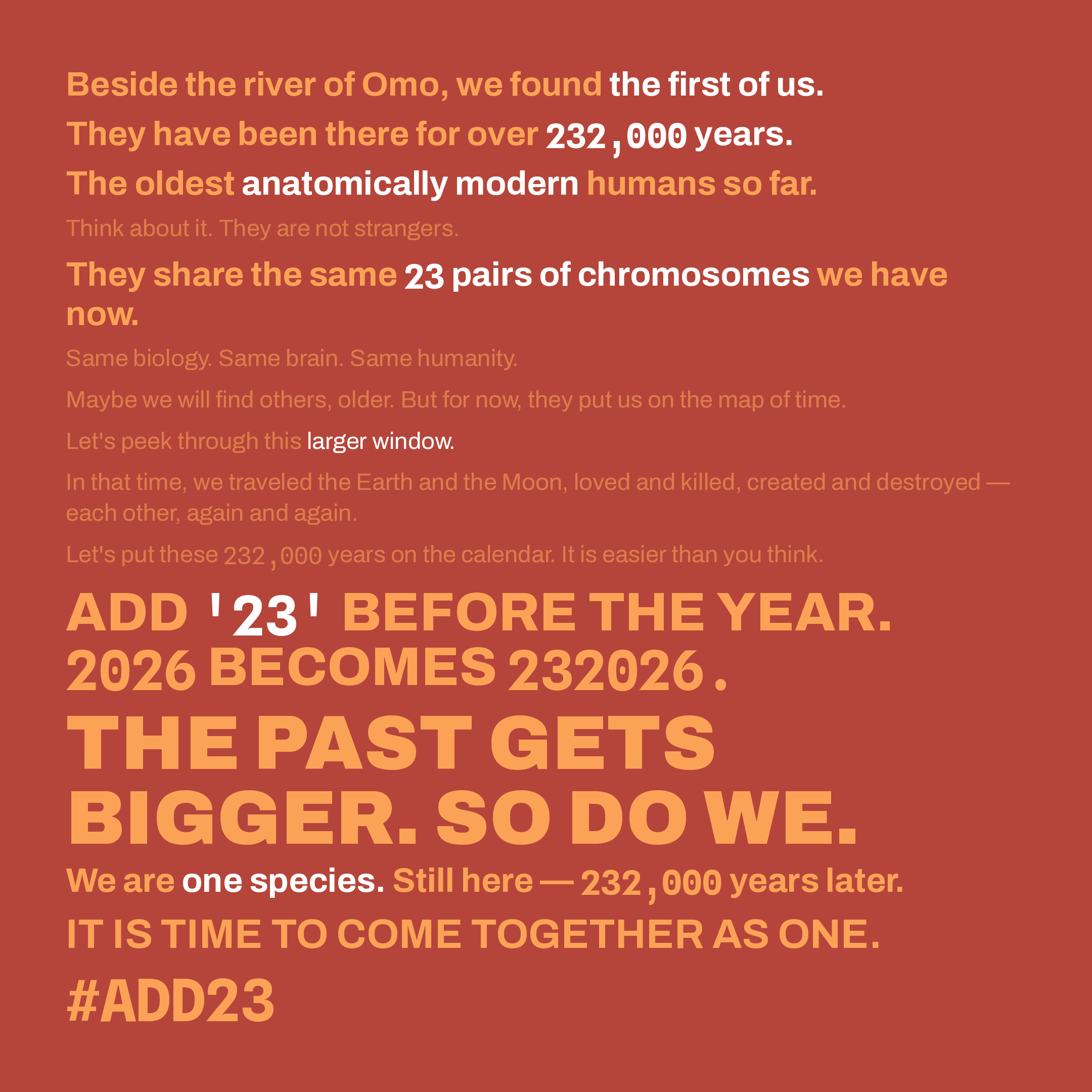
We've been one species for a very, very long time — far longer than the calendar on the wall ever lets us feel. Omoscope exists to make that easy to feel: to step back, take in how long we've all been here, and let that change how we treat each other.
It starts with one small act — adding 23 in front of the year, so 2026 becomes 232026, and our story reaches all the way back to where it really begins: beside the Omo river, with the first of us. Around that idea, a few things have grown — a manifesto, an essay, a calendar, posters — and there's room for more. Omoscope is where they come together, and where the idea keeps moving forward.
The name is simple. Omo is the river where we found the earliest of us. A scope is what you look through to see further. Put them together and that's the whole invitation: look a little further back, and you start to see all of us.
In the lower Omo valley of southern Ethiopia, in a layered formation of ancient sediment and volcanic ash, lie the remains known as Omo I — among the oldest anatomically modern humans ever found.
For decades they were dated to under 200,000 years. In 2022, a team led by Céline Vidal matched the ash layer above them to a colossal volcanic eruption and pushed the minimum age back to at least 233,000 years.
They are not strangers. They carried the same 23 pairs of chromosomes we carry now. Same biology, same brain, same humanity. They put us on the map of time — and we have barely looked at it.
Add 23 before the current year. That's the whole idea. The number you add is the number of chromosome pairs you carry — and roughly the age of our species in thousands of years.
We have been one species for 232,000 years, but we count time as if we began last week. The long-form piece on why the shape of our calendar shapes how we see ourselves — and what changes when the past gets bigger.
Get the long-form manifesto, first access to the objects, and a single email when something matters. No noise.